


I’ve been in marketing and design since 2005...brand strategy, content calendars, social playbooks. I’ve also been a chef...went from line cook to Executive Chef in under two years, opened restaurants, and now run the culinary arm of our studio. I’m a multi-hyphenate, and I’ve stopped pretending those identities don’t live in the same person. I’ve talked about authenticity with clients across various industries, and I’ve encouraged and consulted friends and colleagues on how to show up with intention, lead with values, and build trust over time.
And for fifteen years, I had almost no idea how the systems I was navigating actually worked behind the scenes. It all felt like a game, and I never had an owner’s manual or the cheat codes.
My husband Yas has changed that for me. He’s our Co-Founder and Chief Strategy Officer at The Freckled Fork Collective (more on this later), but before that, he spent over fifteen years in the digital marketing world...most recently as Head of SEO/AEO at Omnicom Media Group, the largest publicly traded marketing company in the world, where he worked with some of the biggest brands in the world such as Proctor & Gamble, Warner Bros. and more. Edward Sturm was a former employee of Yas’ in the agency world who is now an SEO/ marketing influencer with over 700k followers across his socials. Yas cringes every time, but Edward continues to refer to Yas as the King of SEO on his podcasts…and honestly, the title fits. He came to this world through film studies and photography, which means he sees the architecture underneath the feed the way a director sees a frame: as something deliberately composed, with specific intent, serving someone’s vision.
When we started working on The Freckled Fork together, Yas started walking me through the digital world’s true mechanics and how it all actually works. Like a slow, patient, and occasionally maddening education that I kept resisting because part of me didn’t want to know.
Because knowing changes things.
Today I wanted to kick off part 1 of a 3-part series sharing what I’ve learned...about the machine, about what it’s costing us, and about why, even knowing all of this, we’re still in it...and what we think that means.
The Push and the Pull
Every major digital platform you use...Instagram, Pinterest, TikTok, YouTube, Facebook, Spotify...run on algorithms. Often referenced as one big old singular monster (“the algorithm”), it’s not actually just one. There are SO many algorithms, different ones for each platform, all layered and all constantly learning. While the specifics differ by platform, they actually share a single organizing principle: the goal is to keep you on their platform longer. It’s not because they care about you…quite the contrary! Your time on their platforms is what they sell to advertisers. Guys, we are not the customer; we are the freaking product.
There are two fundamental ways content reaches you through these systems, these algorithms, and Yas was the first person who helped to make this distinction land for me. It’s all about the push and pull.
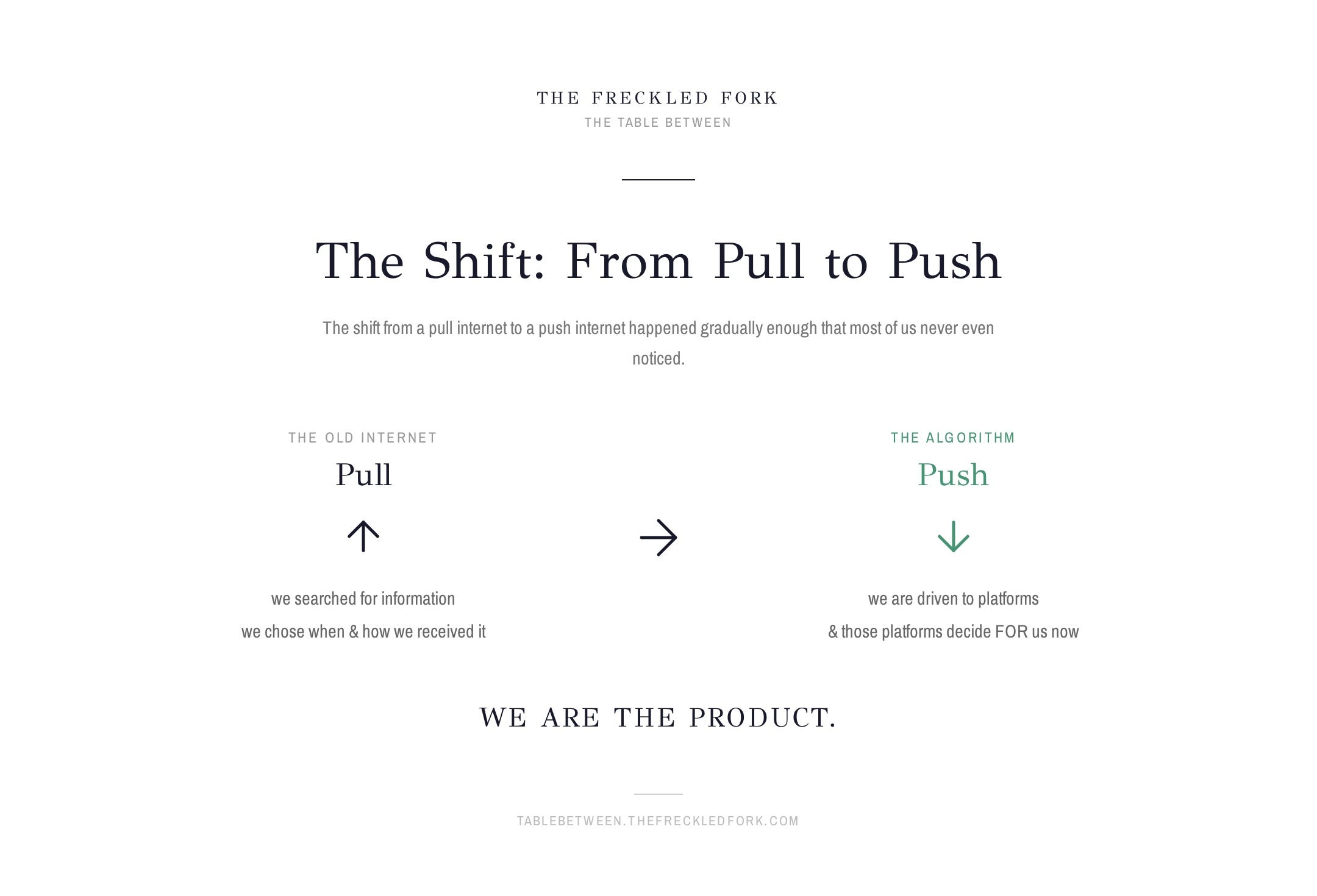
Pull is what you seek out...you Google (or sometimes YouTube) something, you search for a recipe, you type a question into a search bar. You are the agent...you have a need, and you’re reaching and asking for information to fulfill that need. At its best, pull media is here to serve you.
Push is what finds you…Instagram’s feeds/reels/explore, TikTok’s for you/feed, and Facebook’s newsfeed and reels. You didn’t ask for any of it. The platform decided...based on your behavior, based on your friends, your scroll patterns, your dwell time, your past engagement. Daily, these platforms decide…FOR YOU…what to throw in front of your face.
The shift from a pull internet to a push internet happened gradually enough that most of us never even noticed. I remember in the 90s when my family got our first desktop computer and the internet became a publicly available service. That particular dial-up tune is one I’ll never forget (and yes, I know I’m showing my age now, but whatevs). Those were the days of seeking information, exploring web pages and chat rooms like explorers in a new land. We literally learned how to build websites, edit HTML because of Myspace and customize CSS pages from scratch. We were searching and searching for information, for reach and for access versus being fed it. There was a choice…an agency to it where we could choose what to search and how to find information.
These days, we are more like herded cattle…the PUSH functionality of social media and these platforms doesn’t exist to inform us, or even to connect us, and certainly not to improve our lives. Their primary goal is to keep you engaged long enough to show you another ad. Why do you think these platforms and services are “free” to sign up for? The old adage rings true here as well…nothing is for free.
Understanding this one thing can begin to change how you see or what it means every hour you actually spend online.
The Dopamine Loop
Social media platforms are engineered around the same neurological principles as slot machines. And that’s not even a cute little metaphor I came up with, that’s the dang design…the original intent.
Variable reward schedules...the unpredictability of what you’ll find the next time you open the app…these things all trigger a dopamine release in the brain’s reward system. Likes, comments, shares, and follower counts…all of these function as social validation signals, activating the same neural pathways as physical human connection and approval. The scroll, the pause, the reward, the scroll again.
These things are designed to feel like connection...but they aren’t REALLY connection, are they? It’s a simulation of connection, an illusion of reach that’s optimized for retention.
An estimated 210 million people worldwide meet clinical criteria for internet and social media addiction, with possibly up to 34 million Americans at risk. These are not weak-willed people failing at discipline. These are people being pulled by systems specifically designed to be difficult to resist...designed by some of the smartest engineers in the world, with access to more behavioral data than any previous generation of manipulators has ever had.
Johns Hopkins researchers have been direct about this: social media algorithms are developed by tech experts whose goal is to maximize user engagement and time spent online...not to promote positive mental health. The average American now spends over two hours every day on social media alone. Across a lifetime, that’s more than six years.
6. Years.
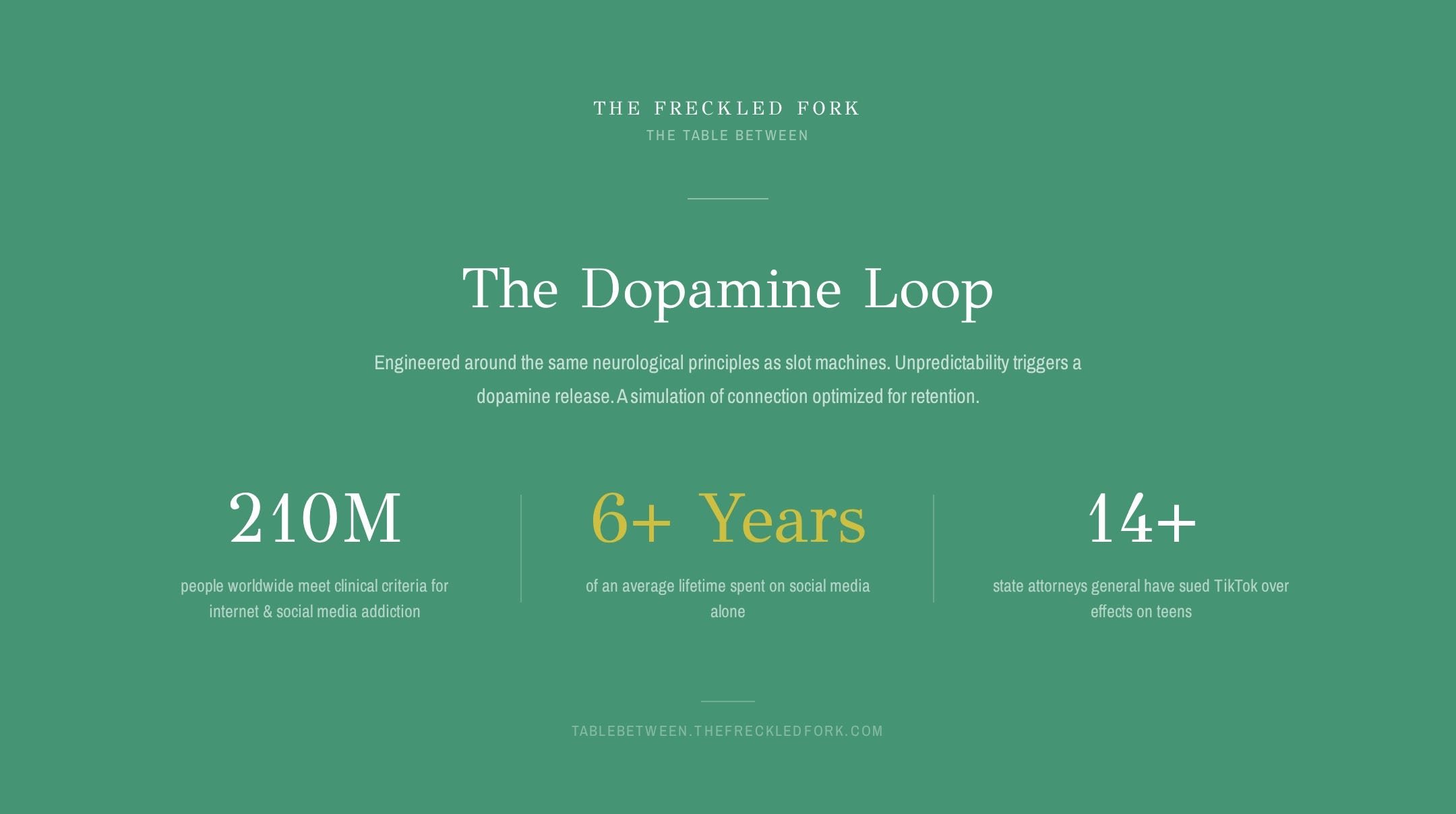
There’s emerging research on what all this scrolling is doing to our actual brains, and it’s finally catching up to what we’ve been feeling. I watched a video recently that did a deep dive into the peer-reviewed science of “brain rot” dissecting the real cognitive effects of short-form video on our attention, our analytical thinking, and our ability to hold a thought long enough to act on it. Researchers are finding that TikTok-style content doesn’t just distract us...it actively degrades our capacity to think critically and remember what we intended to do. Context-switching between fifteen-second clips erodes prospective memory...the memory that helps you follow through on plans, hold intentions, stay present with the people in front of you. More than a dozen state attorneys general have sued TikTok over it. Internal documents show executives knew what the app was doing to teens and kept going anyway. The science is exposing it all, and it’s beginning to confirm what a lot of us have been feeling in our bones.
Predictive Programming and the Machinery of Normal
Yas and I exchange articles almost every day about these things (in addition to various cat memes and posts with tips for navigating our AuDHD + ADHD marriage with grace), and he recently introduced me to a concept that I hadn’t heard of.
It’s called Predictive Programming...it’s the idea, often filed and buried under conspiracy theories, that cultural elites use popular media to condition the public, making future events seem familiar, inevitable, or natural before they actually happen. Things like the Simpsons predicted Trump’s presidency, Contagion and COVID-19 or
The Hunger Games and surveillance states. The theory suggests that repeated fictional exposure to an idea reduces public resistance when the idea arrives in reality. (Insert a certain president’s casual comments and mutterings to completely alter our voting system even as soon as this upcoming fall…just sayin’.)
So maybe you don’t have to completely buy in or believe these coordinated elite conspiracies to at the very least…on some basic level…find the mechanism interesting (or terrifying). Because the mechanism itself...that repeated exposure to something actually does make it feel normal, inevitable, acceptable...is not entirely a fringe theory. It’s actually basic psychology; it’s the basic principles the advertising industry was built on, and it’s certainly how the almighty algorithm was designed.
Every time a platform decides what you see...what body types appear in your feed, what relationship structures are presented as aspirational, what success looks like, what counts as a beautiful kitchen or a good mother or a fulfilled life...it is conditioning you. Gradually, cumulatively, without your explicit consent.
Whether or not there’s a coordinated hand behind it almost doesn’t matter. The effect is the same: our sense of what’s normal, possible, and desirable is being quietly, continuously shaped by a system whose incentives have nothing to do with our actual well-being.
Nope, not a conspiracy…that’s the dang reality that feeds us.
The Infinity Ladder
Before the internet, we compared ourselves to the people we actually knew...your classmates, your neighbors, your family members, people at church, the parents at school pickup, co-workers we saw every day. Psychologists call this your “reference group,” and research consistently shows that the respect you earn within it...the regard of people who actually know you...is one of the strongest predictors of lasting wellbeing.
The digital age collapsed the reference group.
Now we compare ourselves to millions...algorithmically curated millions, filtered to surface the highest-performing, most aspirational, most engagement-generating content available. The images in your feed have nothing to do with what human life actually looks like...they’re the cream of the algorithmic crop, specifically optimized to provoke a response from you. And inadequacy, it turns out, is a very reliable response…and one that they can profit from.
Your local ladder got replaced by an infinite one where you can never see the top...because the top doesn’t exist. Status used to be something you could get and hold...the house, the car, the corner office. Now it’s knowledge, taste, follower count, and aesthetic. And these things are radically unstable, constantly shifting, and always requiring endless maintenance.
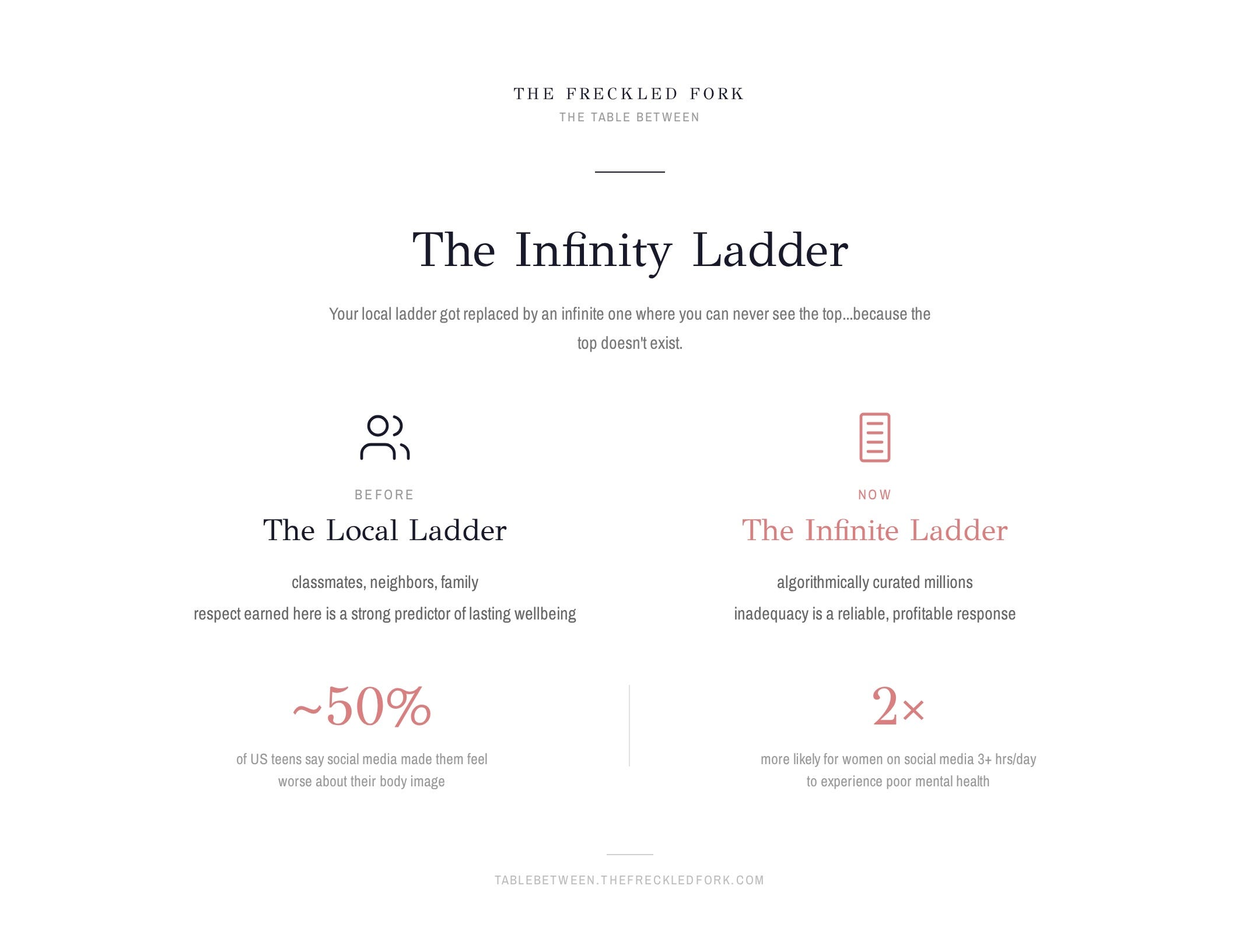
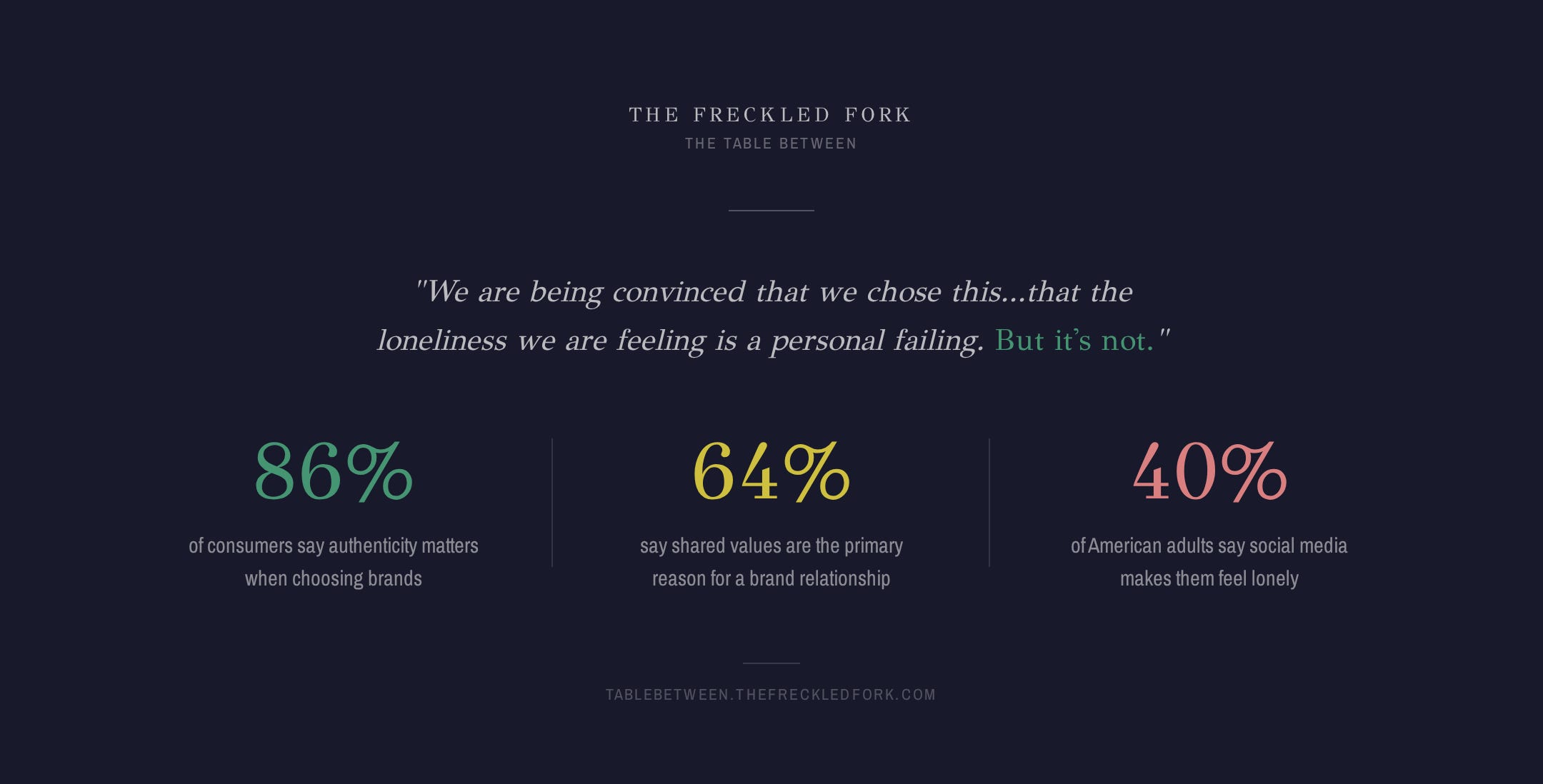
This is the engine fueling a significant chunk of consumer debt…it’s what’s lurking beneath the overwhelming exhaustion that women are feeling (disproportionately, I might add) and it’s infecting us all in this epidemic of body dissatisfaction (nearly half of all US teens say social media made them feel worse about their body image). Women who spend more than three hours a day on social media are twice as likely to experience poor mental health outcomes, and for all of us, 40% of American adults say social media makes them feel lonely or isolated.
The algorithm was never neutral; it was never meant to be. It was optimized...measurably and demonstrably...at our expense.
The Loneliness Business
In 2023, U.S. Surgeon General Vivek Murthy declared loneliness a national epidemic. The World Health Organization has named it a global health crisis...and in our post-pandemic world, one in six people worldwide experiences persistent loneliness. Social isolation carries health risks equivalent to smoking fifteen cigarettes a day...it increases the risk of dementia by 50%, heart disease by 29%, stroke by 32%. Nearly three in five Americans say no one truly knows them.
I’ve talked for years about the human need to belong, to be seen and known. I posted about it on my Instagram and Facebook feeds, on my very first blog, The Lovely Huckleberry, and it’s resonated with me throughout my time in the kitchen. And yet, at the same time, these platforms I’ve posted to are the ones most associated with our diminished connection, and continue to grow. Irony, much?
Maybe it’s not ironic, not a coincidence. The platforms have capitalized on this from the beginning because loneliness is profitable. Lonely people seek connection, and these platforms offer a simulation of it; the simulation isn’t satisfying or doesn’t quite fix the loneliness we feel, so we return for more. Every time we return, it generates more data, more targeted ads, more revenue.
The loneliness epidemic isn’t happening despite our economic and digital systems...it’s being actively produced by them. And the freaking point that makes me want to flip a table...at the heart of it all, we are actually being told that the problem is us. We are being convinced that we chose this, that we could easily just put our phones down if we really wanted to. We are starting to actually believe that the loneliness we are feeling is a personal failing.
But it’s not.
And, here’s where I’ve noticed in my writing, and especially in my daily life, I tend to only sit with uncomfortable information or negative feelings for a short *moment* before my innate positivity, and Virgo-ness kicks in and immediately wants to find a solution. For so long, I’ve believed that’s so very proactive of me; it’s what helped me get things done. But lately I’ve been wondering if my moving past those feelings so quickly actually diminishes the impact. We can’t hurry pain or grieve or growth. Sometimes, we need to sit with those things and allow them space to do the work. Maybe we need to sit with the feelings of failure and sadness from a 17-yr marriage that didn’t work out, or we need allow the feelings of self-doubt and inadequacy of not being able to make single-motherhood work seamlessly with the 80-hr weeks of the restaurant life, or we actually do the work and take a deeper look at the situations of our past that may have cultivated and contributed to our ingrained people-pleaserness and the reactions of defense that keep our walls of protection locked and loaded. Maybe, just maybe, it’s okay not to present the problem and then immediately provide the 3-step solution to it all in the same piece. Maybe for today, we need to sit with the ick, the lifting of the veil, and wrap our heads around the stats…the peek behind the curtain, and start thinking about what it actually makes us feel.
The algorithm…the infinity loop…the possible predictive programming…the motivation and the profit model of social media platforms…the drinking from the proverbial firehose of all the information being PUSHED to us daily…Does it freak you out? Does it make you angry? Does it make you question your reality? Does it make you think twice about why you feel the way you do? Does it make you wonder what else they might not be showing you and why?
Every time you open Instagram, TikTok, Facebook, or any of these other platforms and feel...overwhelmingly...like your life is less than someone else’s…know now that that feeling didn’t come from nowhere. That feeling you have, that you feel, was designed and produced by a system that is optimized and engineered to make us feel that way…and they are profiting on that feeling…every. single. day.
Start with that..let that reality sink in, and let’s start the conversation about what it all means.
This is Part One of The Feed, a three-part series on algorithms, authenticity, and building something real. Part Two is about community, loneliness, and why none of this is your fault. Part Three is about what we’re actually doing about it.
Jess Haque is the Co-Founder of The Freckled Fork Collective, a culinary and creative agency in New York City. She and her husband, Yas Haque, Co-Founder and CSO, are helping build brands rooted in the values of hospitality. Story and strategy, served with intention.
🙌🏼